
Finding Steadiness in a Noisy World
There is an incredible amount of noise in our world right now.
Political division fills our screens. Artificial intelligence is changing how we work, communicate, and understand what is real. Conflict between nations reaches us almost as it happens. We are exposed not only to the challenges of our own lives, but also to the fear, anger, and uncertainty of people around the world.
Even when we are not directly involved, our bodies can still respond.
When the World Enters the Nervous System
Following the Boston Marathon bombings, researchers studied the effects of repeated media exposure. They found that people who watched six or more hours of bombing-related coverage each day reported greater acute stress than people who experienced direct exposure at or near the bombing site.
The lesson is not that we should ignore the world. It is that repeated exposure can keep the mind and body responding to a threat long after we have received the information we need.
Our stress response is designed to protect us. When the brain senses possible danger, breathing may become shorter, muscles tighten, the heart works harder, and stress hormones prepare the body to act.
This response is essential when danger is immediate. The difficulty is that modern life can activate it repeatedly through headlines, alerts, arguments, uncertainty, and the feeling that we must keep checking to see what will happen next.
The body also needs a way to return to balance.
This Is One Reason We Practice
Harvard physician Herbert Benson described the relaxation response as the body’s natural counterbalance to the fight-or-flight response. Research involving Harvard Medical School and Massachusetts General Hospital has found that practices combining focused attention, conscious breathing, meditation, and yoga can produce measurable changes in biological pathways associated with stress.
The research does not suggest that one yoga class removes the pressures of life. It suggests that the body possesses a natural capacity to move out of prolonged activation—and that this capacity can be practiced.
A 2017 meta-analysis published in Psychoneuroendocrinology examined 42 randomized studies involving yoga and mindfulness-based practices. Compared with active control groups, these practices were associated with improvements in physiological measures that included cortisol, resting heart rate, blood pressure, and heart-rate variability.
Conscious breathing may be an important part of this process. A systematic review of diaphragmatic breathing studies reported improvements in measures such as respiratory rate, blood pressure, salivary cortisol, and perceived stress. The number of qualifying studies was limited, so the researchers also emphasized the need for continued investigation.
Yoga does not remove us from reality. It helps us build a steadier relationship with reality.
Ancient Practice, Continuing Research
Researchers in India are also studying yoga within clinical and mental-health settings.
At the National Institute of Mental Health and Neurosciences in Bengaluru, researchers studied adults receiving yoga therapy, antidepressant treatment, or a combination of the two for major depression. After three months, the yoga groups demonstrated changes involving cortisol and brain-derived neurotrophic factor, or BDNF—a protein involved in the brain’s capacity to adapt and form new connections.
This was a small clinical study involving a specific population. It does not mean yoga should replace mental-health care or medication. It does offer an interesting biological view into the possible relationship between yoga, stress regulation, mood, and the brain’s ability to adapt.
Research from Brown University offers a community perspective. In a randomized study of 96 college students, those completing a nine-week mindfulness program experienced improvements in overall well-being and reductions in loneliness compared with the control group during an increasingly stressful academic term.
Taken together, this growing body of research points toward something both simple and powerful.
Returning to What Is Here
Through movement, breath, and focused attention, we practice noticing activation without immediately being controlled by it.
We begin to recognize that discomfort does not always mean danger. Every thought does not require a response. Every headline does not need to enter the body and remain there.
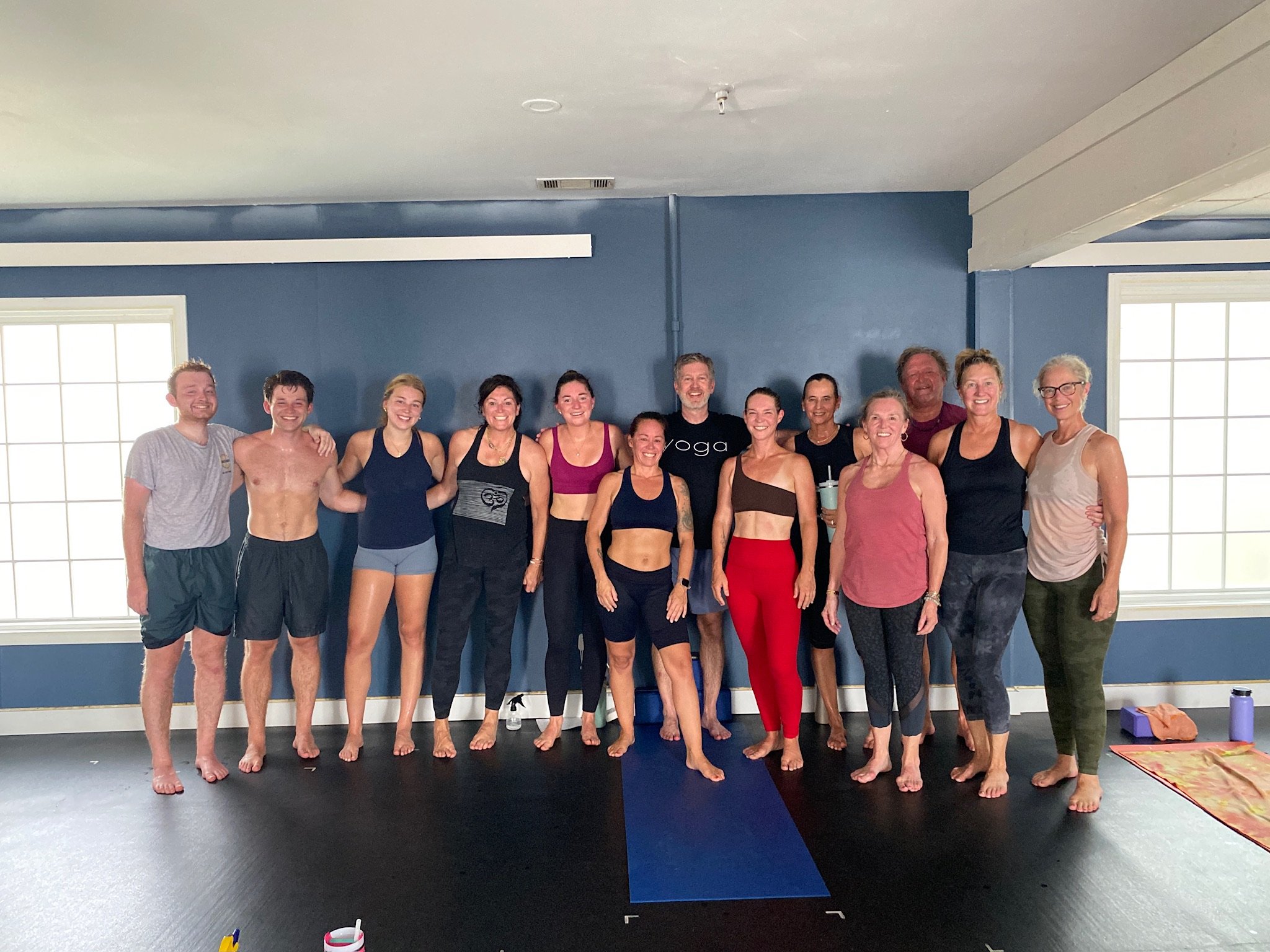
For an hour, we return to what is actually here: our feet on the mat, the movement of the breath, the challenge of the posture, and the presence of the people practicing beside us.
We cannot control every political decision, technological change, or conflict unfolding in the world. But we can practice meeting uncertainty without surrendering our clarity, compassion, or connection.
In a noisy world, yoga gives us a place to become steady enough to listen, strong enough to remain present, and clear enough to choose how we respond.
Research and Further Reading
Holman EA, Garfin DR, Silver RC. “Media’s Role in Broadcasting Acute Stress Following the Boston Marathon Bombings.” Proceedings of the National Academy of Sciences. 2014;111(1):93–98. Read the study
Bhasin MK, Dusek JA, Chang BH, et al. “Relaxation Response Induces Temporal Transcriptome Changes in Energy Metabolism, Insulin Secretion and Inflammatory Pathways.” PLOS ONE. 2013;8(5). Read the study
Pascoe MC, Thompson DR, Ski CF. “Yoga, Mindfulness-Based Stress Reduction and Stress-Related Physiological Measures: A Meta-Analysis.” Psychoneuroendocrinology. 2017;86:152–168. View the study on PubMed
Hopper SI, Murray SL, Ferrara LR, Singleton JK. “Effectiveness of Diaphragmatic Breathing for Reducing Physiological and Psychological Stress in Adults: A Quantitative Systematic Review.” JBI Database of Systematic Reviews and Implementation Reports. 2019;17(9):1855–1876. View the study on PubMed
Naveen GH, Varambally S, Thirthalli J, et al. “Serum Cortisol and BDNF in Patients with Major Depression—Effect of Yoga.” International Review of Psychiatry. 2016;28(3):273–278. View the study on PubMed
Loucks EB, Nardi WR, Gutman R, et al. “Mindfulness-Based College: A Stage 1 Randomized Controlled Trial for University Student Well-Being.” Psychosomatic Medicine. 2021;83(6):602–614. Read the study